In
Hong Kong, with an aging population, caregiving has become an unavoidable topic
for every family.
In the recently released 2026/27 Budget, the government has introduced significant measures to address the challenges of an aging society. As the demographic shift continues, it is projected that by 2046, one in every three Hong Kong residents will be aged 65 or older. In response to this irreversible trend, the Financial Secretary officially announced in the Budget a further increase in the quotas for the Community Care Service Voucher (CCSV) and the Residential Care Service Voucher (RCSV), aiming to empower elderly individuals and their families with greater autonomy through financial means.
Specifically, starting from the next financial year, the government will increase the number of CCSVs by 4,000, bringing the total from the current 12,000 to 16,000. However, Hong Kong still faces deep structural challenges, including population pressure, insufficient management of chronic diseases, caregiver stress, and a shortage of professional manpower. Against this backdrop, person-centered home care and long-term care services are becoming increasingly vital.
Many elderly people wish to age in place: staying in a
familiar community and environment. However, with children busy at work and a
lack of professional nursing staff at home, this wish is often difficult to
fulfill.
While
there are government-subsidized elderly day care centers or enhanced home care
services, the waiting times are often long. To fill this gap, the Social
Welfare Department has regularized the Community Care Service Voucher (CCSV)
for the Elderly. By 2026, the CCSV has become a vital support for many families
seeking home-based care.
What
exactly does this voucher include? How do you apply? How much does it cost?
This article provides the most detailed 2026 guide for you.

What
is the CCSV? Core Concepts Explained
The
Community Care Service Voucher (CCSV) Scheme for the Elderly is a significant
government policy that breaks traditional subsidy models.
The
"Money-Follows-the-User" Concept
In
traditional subsidies, people wait for institutions; the government funds NGOs,
and the elderly passively wait for a vacancy. The CCSV operates on a
"money-follows-the-user" basis: the government issues electronic
vouchers directly to eligible seniors. Like using a consumption voucher,
seniors can freely choose and purchase suitable services from recognized
service providers across 18 districts (including NGOs, private organizations,
and social enterprises).
Flexible
Mixed Mode
The
greatest advantage of the CCSV is the "mixed mode." Seniors are not
forced to choose between "going to a center" or "staying at
home." They can choose both:
1. Center-based:
Attending day care centers for activities, rehabilitation training, and social
gatherings.
2. Home-based:
Professional staff coming to the home for wound care, assistance with daily
activities like bathing and toileting, physical therapy, or household cleaning.
This
flexibility is ideal for seniors with fluctuating conditions or varying care
needs.
Who
is Eligible? (2026 Application Threshold)
Not
all seniors over 60 can apply. Applicants must meet the following three
conditions simultaneously:
Basic
Conditions: Aged 60 or above; or Aged 60 to 64 with proven specific
rehabilitation needs.
Physical
Function Assessment:
Must undergo the Social Welfare Department’s
Standardised Care Need Assessment Mechanism for Elderly Services. The
assessment must result in "Moderate Impairment" or "Severe
Impairment." This means the elder requires assistance with daily
activities (such as bathing, dressing, toileting, moving) or cognitive
abilities.
Waiting
List Status:
The senior must be on the Central Waiting List (CWL) for
Subsidised Long-term Care Services. Pro Tip: If the elder is waiting for a
subsidized residential care home (government nursing home), applying for a CCSV
will not cause them to lose their spot on the list. Their status will
temporarily become "Inactive." If their health deteriorates and they
urgently need to move into a home, they can switch back to "Active"
status at any time. This is a flexible arrangement that covers both home and
institutional needs.
What
Services Can use CCSV?
Many
families think the CCSV is only for "hiring someone to come over,"
but its coverage is actually quite broad. Any item provided by a recognized
service unit that fits the individual's Care Plan can be paid for using the
voucher.
Specific
service categories include:
- - Rehabilitation
Therapy: Physical Therapy (PT) or Occupational Therapy (OT) at home or in a
center, post-stroke care, and cognitive training.
- - Nursing
Services: Registered Nurses (RN) or Enrolled Nurses (EN) coming to the home for
wound management, changing gastric or urinary tubes, medication management, and
peritoneal dialysis care.
- - Personal
Care: Caregivers assisting with bathing, feeding, changing diapers, and
lifting/transferring.
- - Home
Support: Household cleaning and, in some cases, meal delivery services.
- - Escort
Services: Escorts accompanying the senior to and from hospitals or clinics for
follow-up appointments.
- - Caregiver
Support: Respite services to give family members a break, and counseling
provided by social workers.
- - Value-added
Services: Some organizations like YDCare provide specialized services such as
pain relief massage and speech therapy.
Payment
Model and Co-payment Table
The
CCSV is not entirely free; it uses a "means-tested" co-payment
mechanism. The Social Welfare Department reviews the income of the senior and
co-living family members (usually not assets) to categorize applicants into six
levels (I to VI).
- - Government
Subsidy: Pays for 60% to 95% of the service fee.
- - User
Co-payment: Pays for 5% to 40% of the service fee.
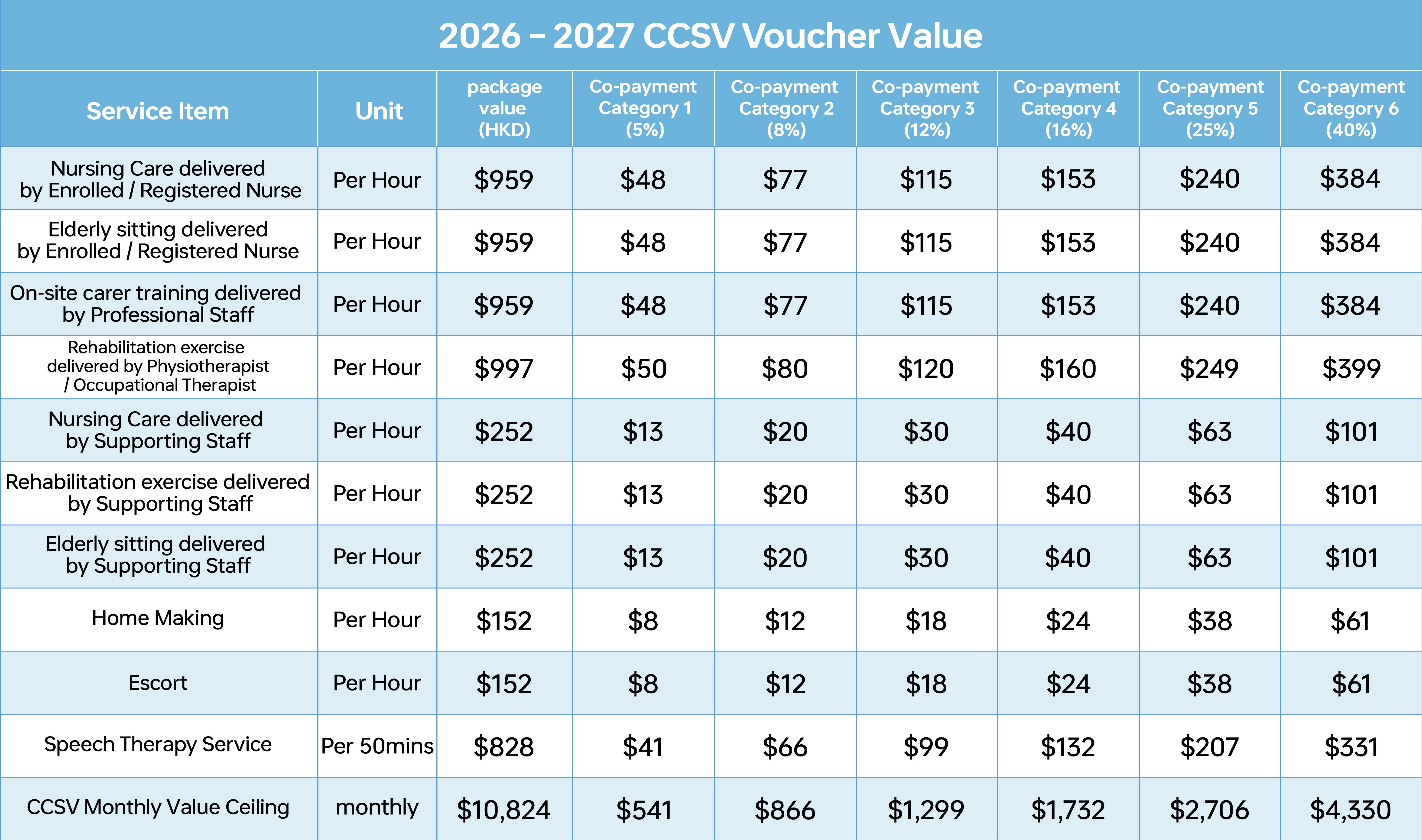
Voucher
Package Value
Seniors
can choose different voucher face values based on their needs (e.g., ranging
from a minimum of approx. $4,000 to a maximum of approx. $10,664, depending on
the figures announced by the department for that year).
Step-by-Step
Application Guide: From Referral to Service
The
application process may seem complex but follows these four steps:
Step
1: Seek Professional Referral
Seniors
or families cannot send a form to the department themselves. You must contact a
social worker (responsible worker) at the following units to request a CCSV
application and a standardized assessment:
1. District
Elderly Community Centres (DECC) / Neighbourhood Elderly Centres (NEC) (for
seniors living in the community) - This is the recommended route.
2. Medical
Social Services Units (for seniors currently in the hospital).
3. Integrated
Family Service Centres.
Step
2: Undergo Standardized Assessment
The
department will arrange for a recognized assessor to conduct a home visit or
hospital assessment.
- Timeframe:
Approx. 4-8 weeks, depending on the district.
- Content:
Assessing care needs and the degree of physical/cognitive impairment.
Step
3: Receive Invitation Letter and Certificate
Once
the assessment is passed (moderate or severe impairment) and a voucher quota is
available, the department will send an invitation letter.
Complete
the enclosed application and income declaration forms. After approval, the
department will mail the "Community Care Service Voucher
Certificate," listing your payment level and effective date.
Step
4: Select and Purchase Services
This
is the most crucial step. The senior needs to contact a recognized service
provider (such as YDCare). The organization will send staff to discuss and
formulate an Individual Care Plan (ICP). Services can begin after signing the
contract.
2026
List of Organizations Accepting CCSV Applications
There
are many elderly centers across the 18 districts of Hong Kong that can assist
with referral applications. To help you find the nearest assistance point, we
have organized the latest list for 2026. As the list is extensive, we recommend
clicking the link below to search by your residential area (e.g., Kwun Tong,
Sha Tin, Central and Western):
Click
to view: 2026 List of Organizations for CCSV Application and Referral byDistrict
(Tip:
Choosing an elderly center near your home makes future follow-ups more
convenient.)
FAQ
Q:
If I apply for the CCSV, can I still hire a domestic helper?
A:
Yes. There is no conflict between the two. In fact, many families use a
"Domestic Helper + CCSV" dual-track approach. The helper handles
daily housework and basic monitoring, while the CCSV is used for professional
nurses to clean wounds or physical therapists for rehab, filling the gaps in a
helper's professional knowledge.
Q:
How long does it usually take from application to someone arriving at home?
A:
For new cases, it takes about 1-2 months from seeing a social worker to
completing the assessment. After receiving the certificate, finding an agency
takes about 1-2 weeks. The total timeframe is about 2 to 4 months. Compared to
waiting for a nursing home or government-subsidized home services (IHCS) which
can take over six months, the CCSV is the fastest route.
Q:
If I am dissatisfied with the current service provider, can I switch?
A:
Absolutely. This is the greatest right under the CCSV. Simply notify the
current agency to stop services (usually requiring a notice period), and you
can take your voucher to another agency without needing re-approval from the
department.
Q:
Can I use more than one service provider at the same time?
A:
Yes. According to the current mechanism, a voucher holder can purchase services
from up to two recognized service units in the same month. This allows for more
flexibility, such as choosing a day care center for social activities and
another home care agency for bathing or rehab services. However, coordinating
between two agencies may require more effort from the family (e.g., handover of
records). Therefore, many savvy caregivers prefer providers like YDCare that
offer comprehensive services under one professional team.
Why
Choose YDCare?
When
you hold a voucher and face hundreds of agencies, how do you choose? General
agencies often only focus on "dispatching staff," leading to
inconsistent quality and leaving families with no one to turn to when problems
arise.
YDCare
redefines the standard of home care. We are not just an agency; we are your
family's health manager.
1. Supervision
by Full-time Nurse Managers
This
is a core advantage of YDCare. Very few private care companies in Hong Kong
employ full-time Nurse Managers.
- - Professional
Consultation: You don't have to wait for a hospital follow-up to ask questions.
If there is an emergency or you don't know how to handle a situation, our
clients can seek professional advice from the Nurse Manager at any time.
- - Case
Management: The Nurse Manager proactively reviews the effectiveness of the care
plan to ensure the elder receives the most appropriate care.
2. Evening
and Overnight Care Services
The
pressure on caregivers often peaks late at night. Many seniors experience
frequent night urination or "sundowning" (nocturnal confusion),
leaving families exhausted.
- - 24/7
Support: While most agencies only provide daytime services, YDCare understands
that care is a 24-hour challenge. We provide evening and overnight care
services, with trained staff monitoring the senior's toilet needs and
preventing falls throughout the night.
- - Peace
of Mind: This allows you to sleep well so you have the energy to work or care
for your family the next day.
3. 100%
Face-to-Face Interviews and Handover Reports
We
understand the concern of bringing strangers into your home.
- - Strict
Screening: Every caregiver at YDCare (whether a domestic assistant or health
worker) must pass a face-to-face interview and credential verification. We
never perform blind matching.
- - High
Transparency: We require staff to submit nursing handover reports. What did the
elder eat today? How is the wound? What is the rehab progress? Family members
can see everything at a glance, providing peace of mind even when you aren't
there.
4. Diverse
Services Beyond the Standard
Care
should be personalized, not a rigid package. Beyond standard nursing and rehab,
we offer pain relief massage therapy to effectively alleviate joint pain and
improve quality of life.
From
domestic assistants to professional therapists, our spectrum of services is
flexible and can be adjusted anytime as the senior's condition changes.
Don't
let complicated caregiving tasks overwhelm your life. Make good use of the 2026 CCSV Community Care Service Voucher and choose the most professional partner.
Contact
the YDCare nursing team today to schedule a free care consultation and let us
create the most suitable aging-in-place plan for you.