Home Parenteral Nutrition (HPN) Support During Cancer Treatment
by YDCare Homecare Team
|
May 15,2026
During
cancer treatment, Mrs. Chan became increasingly weak and her oral intake
remained poor. Her family watched meals being placed by her bedside and then
taken away almost untouched. They were worried, but they also felt helpless.
After medical assessment, her doctor recommended Home Parenteral Nutrition
(HPN) so that she could receive nutritional support at home when eating enough
by mouth was no longer realistic.
For
the family, HPN was not simply “hanging up a nutrition bag.” It involved
catheter care, needle management, infusion timing, infection prevention, and
knowing what to do after the infusion was completed. At the beginning, the
family was unsure which medical items were needed, what specifications to buy,
and how much to prepare. They were also afraid that touching the catheter
incorrectly might increase Mrs. Chan's risk of infection.
After
understanding Mrs. Chan's condition and the doctor's instructions, YDCare
arranged registered nurse home visits three days per week
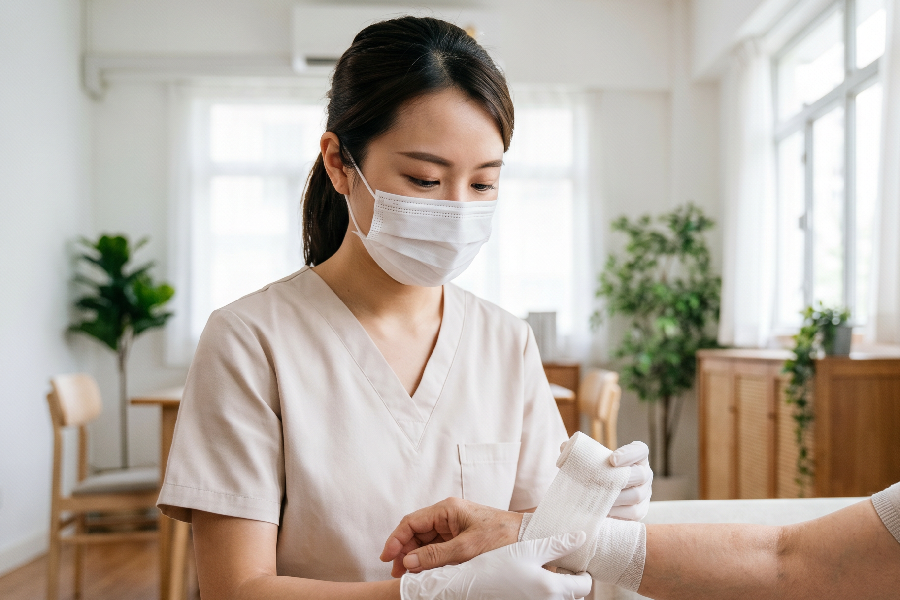
for six months. On each infusion day, the nurse visited twice. During the first
visit, the nurse assessed the catheter and access site, performed the required
disinfection procedure, inserted the necessary needle, and confirmed the
infusion arrangement so that the treatment could begin safely. After the HPN
infusion was completed, the nurse returned to remove the needle, reassess the
catheter and skin condition, and observe Mrs. Chan's overall condition,
including any redness, leakage, pain, fever, or other warning signs.
Over
time, the family moved from being afraid to touch or even ask about the
catheter to understanding the purpose behind each step. The nurse explained in
plain language what they should observe, such as whether the dressing was
loose, whether the skin around the catheter looked red, and which changes
should be reported immediately. When basic family involvement was appropriate,
the nurse demonstrated the required steps according to clinical instructions
and made sure the family understood them, rather than leaving them to figure
things out on their own.
The
required medical consumables and nursing supplies were also prepared and delivered to
your
place by the us. For the family, this was not just
a matter of convenience. It meant they no longer had to worry about buying the
wrong items, missing something important, or preparing insufficient supplies. A
treatment that once felt frightening gradually became a clear, structured, and
supported home care routine.
For
Mrs. Chan and her family, the biggest change was not simply that a medical
procedure could be done at home. It was that Mrs. Chan could avoid unnecessary
travelling and rest in a familiar environment, while her family no longer had
to face catheter and infusion-related concerns alone. HPN remains a complex
treatment that requires professional handling, but with the right support, it
can be carried out safely and systematically at home.
Service
Highlights:
•
Registered nurse HPN support according to the doctor's prescription
•
Assessment and observation of the catheter, access site, and surrounding skin
•
Assistance with pre-infusion preparation, needle management, post-infusion
checking, and related care
•
Family guidance on basic catheter and dressing observation when appropriate
•
Preparation and delivery of required medical consumables for a clearer and more
organised care process
•
Reduced travelling burden for the patient and improved feasibility of
home-based care
Helpful
Reminder: Home Parenteral Nutrition (HPN) must be prescribed after medical
assessment. Infusion and catheter-related care should be performed by
registered nurses according to clinical instructions. YDCare can assist with
doctor referral and related home nursing arrangements when needed.
For enquiries about Home Parenteral Nutrition (HPN) or other complex home nursing care, please contact YDCare.
Read More:
Home Parenteral Nutrition (HPN): Infection Risks and Key Prevention Points
Catheter Care at Home: Five Key Tips to Prevent Infection