More and
more families are now living
across different countries, typically with
adult children overseas while their parents staying in Hong Kong. As long as parents are still independent, the
drawbacks are invisible. But after a fall, hospital
admission, surgery or gradual decline in mobility, everyday tasks can become
much harder.
For
families living abroad, the first question is not necessarily whether to hire a
nurse. It is to understand where support is actually needed and whether
that support should come from a caregiver, healthcare worker, nurse or
rehabilitation professional.
When
Might Your Parents Need More Support?
The
need for home care is not determined by diagnosis alone. The
core issue is whether your parents can still manage daily
living safely and consistently.
It may
be time to review their care arrangements if they:
- - Need help with bathing, dressing,
toileting or meals
- - Find getting in and out of bed or
leaving home more difficult
- - Are walking more slowly or
starting to rely on walls, a walking stick or frame
- - Have fallen, or have had several
near-falls
- - Now have a wound, urinary
catheter, nasogastric tube, stoma or other nursing needs
- - Are finding medication,
appointments or health monitoring increasingly complicated
When
you live overseas, it can be difficult to judge how
well your parents are doing. Instead of
only asking whether they feel unwell, it can be more helpful to ask whether
they are still managing bathing, meals, mobility and daily routines as they
used to.
What
Type of Home Care Do They Need?
Not
every elder needs a nurse, and
not every problem can be managed by a general caregiver. The right level of
support depends on the main difficulty your parents are facing.
Help
With Daily Living: Healthcare Workers or Caregivers
If your
parents are medically stable but need help with everyday activities, a healthcare
worker or caregiver may be the most appropriate option.
Support
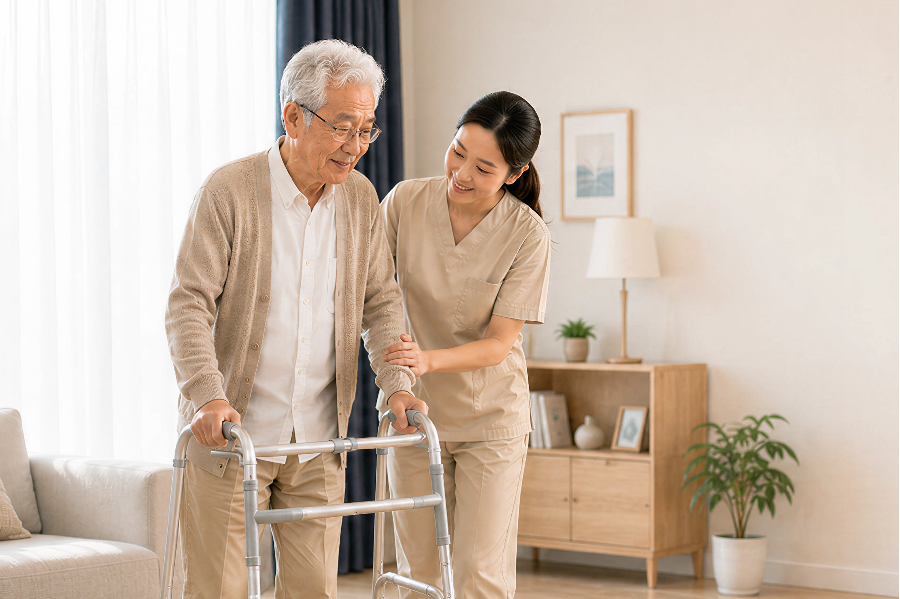
may include bathing, toileting, dressing, meals, transfers, walking assistance
and general daily care.
This is
often suitable for someone who has become weaker after a hospital stay or
fracture but does not have complex medical needs. Longer day or night shifts
can also be arranged when more continuous supervision is needed.
Medical
or Nursing Needs: Home Nursing
A nurse
may be more appropriate when care involves clinical procedures or ongoing
health assessment, such as:
- - Wound or pressure injury care
- - Urinary catheter, PICC, Port or
other line care
- - Nasogastric tube or stoma care
- - Post-operative nursing
- - Vital-sign and health monitoring
- - More complex medication or
treatment plans
Home
nurses can provide the clinical care itself while also advising family members
and other caregivers on how to manage the patient safely at home.
Reduced
Mobility: Home Rehabilitation
If the
main problem is weakness, poor balance or reduced mobility after a stroke,
fracture, operation or hospital stay, physiotherapy or occupational therapy
may be more suitable.
Home
rehabilitation can focus on strength, balance, transfers, walking and everyday
function, helping the person regain or maintain as much independence as
possible.
If
There Is Already a Domestic Helper, Is Extra Care Still Needed?
Many families in Hong Kong are having
domestic helpers at home
already. They are capable of preparing meals, cleaning, companionship and general daily support.
However,
as care needs become more complex, a domestic helper may not be enough on their
own.
If the
main difficulty is bathing, transfers, toileting or night-time safety, a
healthcare worker can provide additional support and show the domestic helper safer care techniques.
If
there are wounds, catheters, nasogastric tubes, post-operative needs or ongoing
health monitoring, nurses would be suggested
to take the lead on the clinical side while the domestic helper continues to
support everyday care.
In
practice, a domestic helper, healthcare worker and nurse do not have to be
alternatives to one another. They can work together at different levels
depending on what your parents need.
Further
reading: Hiringa Nurse, Health Worker, or Helper? Understanding the Differences in Home Care
What
Should Overseas Families Look for in a Home Care Provider?
For
overseas families, it is important to know who will be providing the care and
whether they are experienced in addressing your parents’
needs.
It is
also worth checking whether the provider can maintain a relatively consistent
care team, especially for longer-term support.
Finally,
choose a provider that can adjust the care plan as needs change—for example,
moving from daily living support to nursing or rehabilitation after a hospital
admission.
This
gives families better visibility and makes ongoing care easier to manage from
overseas.
You
Do Not Have to Decide Everything at Once
Your
parents’ care needs will change from time to time.
The most practical approach is to start with the support they need now and
adjust the plan whenever their health and
mobility changes.
If difficulties
arise in daily activities, a healthcare worker or
caregiver may be enough. If the situation becomes more complicated, care
needs in wounds, catheters or other clinical develop,
home nursing should be added. For mobility, functional or cognitive declines, physiotherapy or occupational therapy may also become
part of the care plan.
YDCare
can arrange healthcare workers, private caregivers, home nurses and home
rehabilitation services according to your parents’ current needs. Care
arrangements can then be reviewed and adjusted over time, helping overseas
families put in place a practical and sustainable support plan for parents
living in Hong Kong.
Read more:
Caring for a Nasogastric Tube at Home: Feeding, Flushing and Daily Care
After Fracture: Home Care for Elders